US Project Case | 20” A105 Weld Neck Flange
Project details
A US engineering contractor ordered 1,500 pieces of 20” weld neck flanges for a pipeline project in North America. The flanges were manufactured to ASME B16.5 in ASTM A105 forged carbon steel, Class 150, raised face, with standard wall thickness, for high-pressure tie-in work on oil, gas and industrial transmission lines.
Customer Requirements
The order came with original North American engineering drawings, and every dimension had to follow ASME B16.5: 20” NPS, STD wall thickness, Class 150 bolt pattern, raised face sealing surface, weld neck configuration. Material requirements were equally firm.
The customer asked for A105 forged blanks only, backed by complete heat number reports plus mechanical and chemical test data to meet North American pressure equipment regulations.
Machining tolerances were tight across the board — neck taper, bolt hole distribution on the circle, facing flatness, outside diameter and thickness all had to hold within spec so the flanges would weld and bolt up cleanly on site.
Because of the volume, the customer also required batch production with a separate English packing list for every box, and heavy-duty moisture-proof, impact-resistant packing to protect the goods through ocean freight

Drawing Review
Our technical team checked the drawings against ASME B16.5 over several rounds before committing to production. Flange OD, bolt circle diameter, bolt hole size and count, neck taper and height, and RF face roughness were all verified against the Class 150, 20” standard parameters.
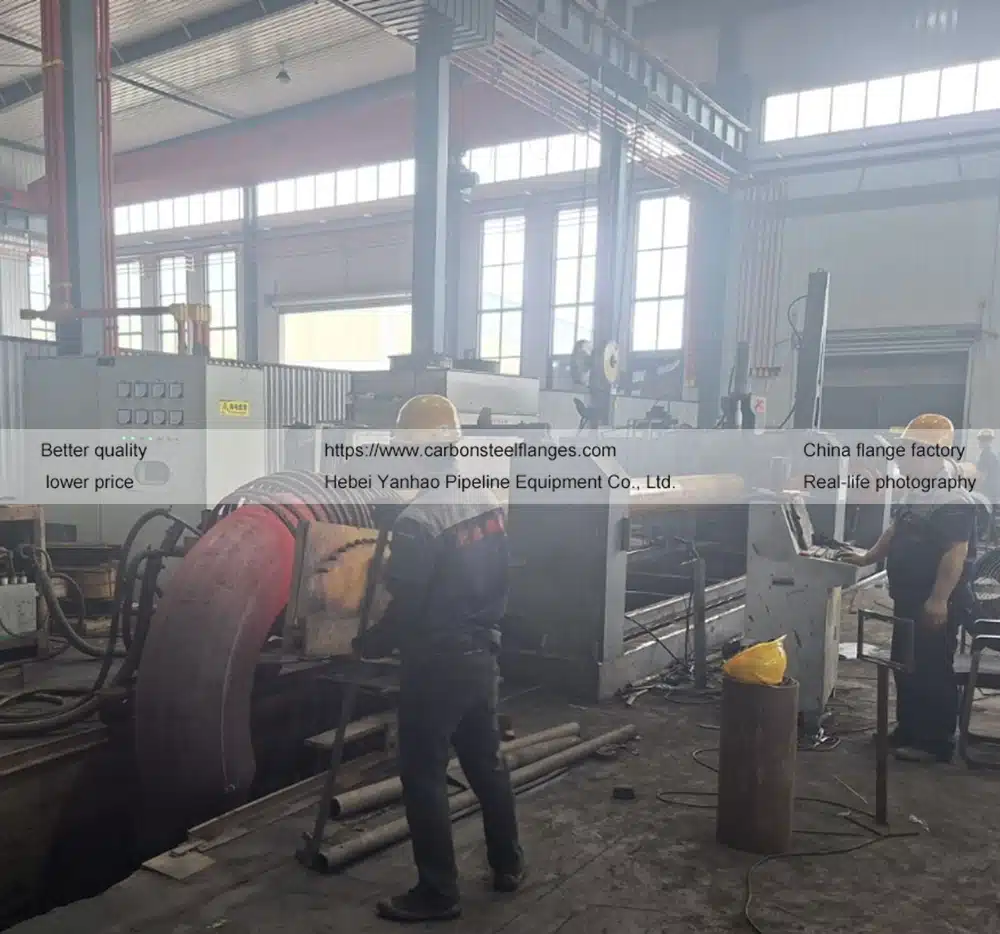
For a flange this size, heat treatment matters. We scheduled normalizing for the A105 forgings to relieve internal stress, which prevents distortion after machining on large-diameter parts. The machining route was set up on a CK5112 CNC vertical lathe and a heavy-duty CNC lathe: rough and finish turning of the flange body first, then fine finishing of the sealing face, and finally drilling and tapping the bolt holes. This sequence keeps dimensions consistent across a 1,500-piece run.
Production started only after the first article passed full inspection and the customer approved the sealed sample.


Production and Workshop Inspection
Incoming A105 forgings were tested batch by batch — spectrochemical analysis, tensile and impact testing — with heat number traceability filed for every lot. The flanges were formed on a hydraulic forging press in one piece, then went through a temperature-controlled heat treatment furnace to remove forging stress and bring the parts up to pressure-bearing strength.
Machining ran in a fixed sequence:
- CNC vertical lathe for rough and finish work on the OD and end faces
- Heavy-duty CNC lathe for the weld neck taper
- CNC drilling machine for the bolt hole pattern, keeping hole positions uniform across the batch
After machining, our workshop deburred every flange and gave the sealing faces a dedicated polish and anti-rust treatment. Each production batch went through hydrostatic pressure testing on sampled pieces and flatness rechecks on the sealing faces. At final inspection, our QC team checked appearance and dimensions box by box, pulled out any defective pieces, and released only conforming flanges to packing.
Throughout the production cycle, our merchandiser sent the customer weekly workshop photos and batch inspection reports, so they could follow the 1,500-piece order in real time.


Packing for Ocean Shipment
For a transoceanic shipment of this size, packing was built up in layers:
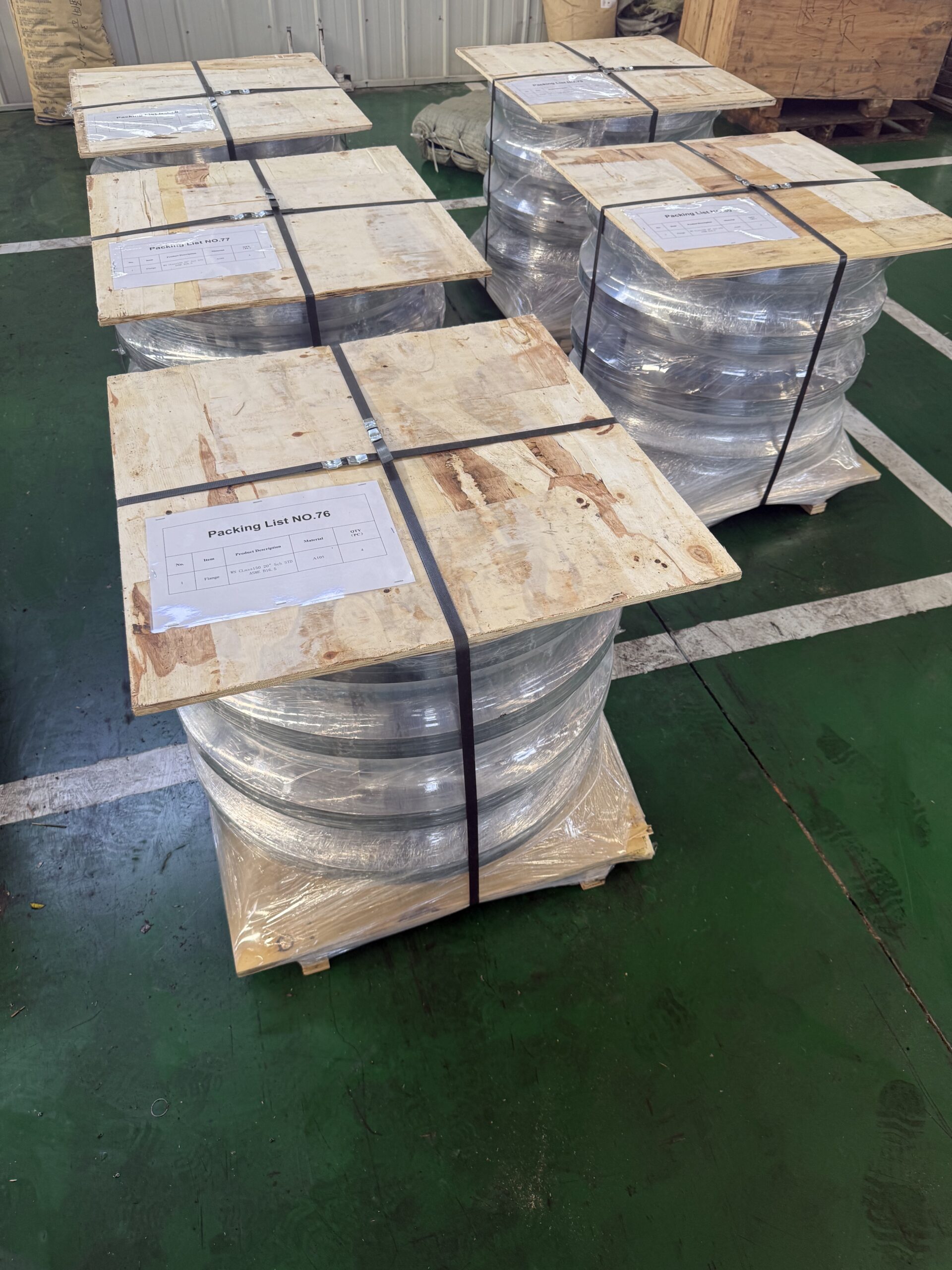
- Each flange was fully wrapped in stretch film to block sea moisture and prevent friction scratches
- Same-spec flanges were stacked on solid wood pallets, capped with reinforced timber battens, and locked down with cross-pattern high-tensile strapping; each unit carried its own English packing list showing box number, quantity, specification and gross weight for customs
- On the truck, the palletized units were arranged in rows and secured with tension straps in both directions to stop shifting during road transfer
- Documentation covered a packing list per box plus a consolidated commercial invoice, material test certificates and inspection reports, all in English, matching US port clearance requirements
Once loading was finished, we sent the customer photos of the full truck arrangement and the box-by-box breakdown.


Delivery Result
The shipment cleared US customs and passed on-site acceptance without issues. Dimensional consistency across the 1,500 flanges met ASME B16.5 in full, pipe welding and bolt assembly went smoothly on site, and the sealed joints held pressure as specified. The export packing arrived intact with no box damage, no rust and no impact marks. The complete traceability file also sped up both customs clearance and project entry acceptance.
The batch has gone into pipeline construction, and the customer has confirmed an annual framework agreement covering additional sizes of ASME B16.5 flanges.






Author: Lewis Liu
Hello, my name is Lewis Liu, and I’m a professional sales engineer with over a decade of expertise in the flange fittings sector.
I am quite informed about flange selection, installation, and maintenance. I am passionate about providing customers with the greatest solutions for keeping their pipeline systems running smoothly, safely, and dependably.
If you have any queries or concerns concerning flange fittings for your pipelines, whether they are about selection, material choice, specification requirements, or anything else, please contact me at any time. I am dedicated to providing expert advice and assistance to help you make educated decisions and reach your objectives.